Starting, charging and wiring · Gladstone, Calliope and surrounds
Flat again? Let’s find out why.
A battery that keeps going flat, a charging warning or an engine that only clicks needs the cause checked. Total Mobile Mechanical Services provides qualified auto-electrical testing and repairs for batteries, alternators, starter motors and wiring, with mechanical and diagnostic support available when the problem goes further.
Call 0456 765 135 with the symptoms and whether the vehicle can be driven. Our main workshop is at 6 Wright Road, Calliope QLD 4680.
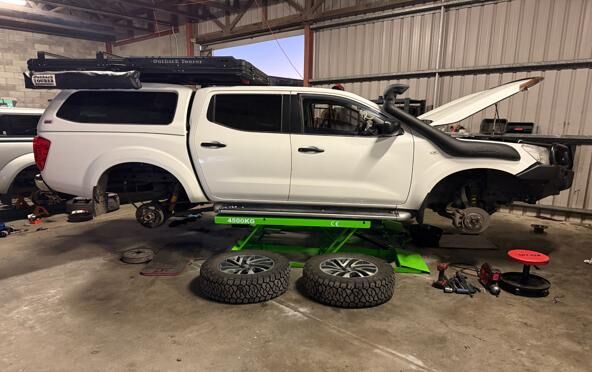
Inside our Calliope workshop.
Complete starting and charging circuits tested
Qualified auto electrician in house
Repair recommendations based on evidence
Get the starting or charging problem understood
Slow cranking, repeated battery discharge and unstable charging can each have several causes. We assess the relevant components and connections together so the proposed repair addresses what the testing finds.
Alternator and charging faults
Check charging voltage and alternator output under load, with attention to drive belts, battery condition, cables, earths, fuses and control wiring. Computer-controlled charging concerns can also require electronic testing before an alternator is recommended.
Starter and no-crank diagnosis
Investigate clicking, slow cranking or no response when starting. Battery voltage, terminals, starter current, earth quality and the control circuit are checked as needed, including relays and switches that affect the starting command.
Repeated flat batteries
Assess battery condition and capacity alongside charging performance and unwanted current draw after shutdown. A battery that repeatedly needs charging may have its own fault or be responding to a problem elsewhere in the vehicle.
Find poor connections, corrosion, damaged strands and high resistance in battery, engine, body and component circuits. Voltage-drop measurements can expose a cable that looks intact but cannot carry the required load reliably.
Damaged wiring and blown fuses
Trace open circuits, shorts, repeated fuse failures and damaged harness sections. Suitable repairs can address overheated cables, terminals, connectors and previous work that has left the circuit unreliable or poorly protected.
Lighting and accessory circuits
Investigate intermittent lights and accessories, with suitable work-light, driving-light and accessory wiring available. Tell us about recent installations, water entry or changes to the vehicle so the testing can consider those connections.
Test the whole circuit before choosing the repair
Charging output depends on more than the alternator
The charging system supplies the running vehicle and restores energy used during starting. Low or unstable output can trigger warnings, electrical resets and poor battery life. If the battery becomes depleted, the vehicle may stop even though it started normally earlier.
Possible causes include a weak alternator, a deteriorated or unsuitable battery, loose or contaminated terminals, a slipping belt, resistance in the positive cable or a poor earth. Fuses, relays, alternator-control wiring and computer-controlled charging also matter. Battery tests, output under load, belt inspection and voltage-drop checks across positive and earth circuits help distinguish them.
Separate a starter fault from a broader no-start
A click does not identify the failed component on its own. A discharged battery, poor terminal, damaged cable, earth problem, relay or control circuit can prevent normal cranking. Park or neutral switches, clutch switches, ignition control, immobiliser faults or an engine unable to rotate can also be involved.
We can check available voltage at the starter, current draw, earth quality and control operation before recommending replacement. If the starter turns the engine normally but it does not run, further no-start diagnosis may be required. Our electrical and mechanical team can continue with that investigation through the same business.
Repeated jump-starts or charging can point to a battery losing capacity, weak charging or an unwanted electrical drain. Modern modules and components may continue operating for a period after the vehicle is switched off. Accurate key-off current testing may therefore require the vehicle to stay at the workshop while systems enter their normal sleep state.
Possible causes include an incorrectly wired accessory, an active relay, a module that stays awake, a hidden light, damaged switch, water entry or communication equipment drawing excessive current. Tell us whether it began after a new battery, accessory installation, collision repair or electrical work, and how long the vehicle can sit before it fails to start.
Repair the wiring fault and keep its protection
Heat, vibration, water, dust and movement take their toll on vehicle wiring. Rodents, collisions, overloaded accessories and previous repairs can also damage a circuit. A fault may remain hidden inside a cable or only appear when a connector moves or heats up.
We inspect and test the affected wiring, fuses, relays, terminals and earths to establish the repair needed. A repeatedly blown fuse requires the short or overload to be found; fitting a larger fuse or bypassing protection can leave the wiring exposed to excessive current. Broader sensor or module faults can continue through our auto-electrical and diagnostic service.
Workshop testing with suitable breakdown assistance
Battery drains, intermittent wiring and repairs needing harness access are usually best handled in the workshop. Stable power, safe access and the equipment for electrical and mechanical checks help the team work through the cause and confirm operation after an approved repair.
Our breakdown ute supports urgent no-start callouts, while our mobile workshop supports planned on-site diagnosis and repairs. Visit our mobile workshop and breakdown service for 24/7 availability, coverage and visit arrangements. Tell us the vehicle, symptoms and location so the team can plan the testing.
A clear description helps us choose the first test
Tell us whether there is no cranking, slow cranking, normal cranking without the engine starting, or a battery that discharges while parked. Mention a charging warning, flickering lights or electrical resets, and whether the fault changes with heat, rain, vibration or accessory use.
Have details of recent batteries, alternators, starter motors, accessory installations and repairs ready. Intermittent problems can take time to reproduce or leave usable evidence. We explain the findings and any further checks required before substantial additional work proceeds.
From starting trouble to the right repair
Describe what happens
Call 0456 765 135 with the vehicle, symptoms, recent work and location. Let us know whether it starts at all or needs repeated charging.
Test the relevant circuits
We assess battery condition, charging or starter operation and connected wiring as the fault requires. Current-draw testing may need workshop time.
Repair and confirm operation
The findings and proposed work are explained. After the approved repair, relevant checks confirm operation and any further concerns are discussed.
Gladstone, Calliope and surrounds.
Starting, charging and wiring repairs for Gladstone, Calliope and surrounds, including Boyne Island, Tannum Sands, Mount Larcom, Benaraby and Miriam Vale. Our main workshop is at 6 Wright Road, Calliope QLD 4680. Call with your location when discussing help for a vehicle that cannot be driven.
Starting and charging questions
Does a flat battery need replacing?
Testing needs to establish that. Discharge may come from charging faults, an electrical drain, poor connections or short driving patterns. We check battery capacity and the relevant vehicle systems before recommending replacement.
Can an alternator be tested before replacement?
Yes. Output under load, charging voltage, cable voltage drop, earth quality, belt condition and control wiring can help establish whether the alternator or another part of the system is at fault.
Why does the starter only click?
A weak battery, poor connection, damaged cable, relay, starter fault or engine unable to rotate can all produce a similar symptom. The starting circuit needs assessment to determine the cause.
Can you find a wiring fault that comes and goes?
Often, although intermittent faults may need extra time to reproduce or gather evidence. Details of temperature, rain, vibration and accessory use help guide the investigation.
Can mobile support help with a no-start?
Suitable jobs may receive initial mobile assessment and practical repairs. The findings determine whether further testing or a larger repair needs workshop facilities.
Get to the cause of the next no-start.
Call Total Mobile Mechanical Services on 0456 765 135 for charging-system, starter, battery-drain or wiring diagnosis. Tell us what the vehicle does and we will help arrange the most useful first check.